Sunday, August 25, 2019

Fire Forecast Amazon Region


The fire season in the southern Amazon runs from June to November, with peak burning activity in September along the eastern and southern Amazon forest frontiers, a swath sometimes referred to as the "arc of deforestation". Year-to-year variability in fires is strongly linked to climate anomalies, and both the El Niño Southern Oscillation in the Pacific Ocean and Atlantic Multi-decadal Oscillation influence drought conditions and the risk of fires across the southern Amazon.


2019 Fire Season Updates:

August 24th, 2019
Figure: Cumulative active fire detections through 8/22/2019 from MODIS and VIIRS confirm that 2019 is the highest fire year since 2012 (the start of the VIIRS record) across the seven states that comprise the Brazilian Amazon. In addition, fires in 2019 are more intense than previous years, measured in terms of fire radiative power, consistent with the observed increase in deforestation

Saturday, August 3, 2019

July equalled, and maybe surpassed, the hottest month in recorded history


According to new data from the World Meteorological Organization and Copernicus Climate Change Programme, July at least equalled, if not surpassed, the hottest month in recorded history. This follows the warmest ever June on record.

The data from the Copernicus Climate Change Programme, run by the European Centre for Medium-Range Weather Forecasts, is fed into the UN system by WMO. The figures show that, based on the first 29 days of the month, July 2019 will be on par with, and possibly marginally warmer than the previous warmest July, in 2016, which was also the warmest month ever.

The latest figures are particularly significant because July 2016 was during one of the strongest occurrence of the El Niño phenomenon, which contributes to heightened global temperatures. Unlike 2016, 2019 has not been marked by a strong El Niño.

"We have always lived through hot summers. But this is not the summer of our youth. This is not your grandfather's summer," said UN Secretary-General António Guterres, announcing the data in New York.

July 2019 will be around 1.2°C warmer than the pre-industrial era, according to the data.

"All of this means that we are on track for  the period from 2015 to 2019 to be the five hottest years on record. This year alone, we have seen temperature records shattered from New Delhi to Anchorage, from Paris to Santiago, from Adelaide and to the Arctic Circle. If we do not take action on climate change now, these extreme weather events are just the tip of the iceberg. And, indeed, the iceberg is also rapidly melting," Mr Guterres said.

"Preventing irreversible climate disruption is the race of our lives, and for our lives. It is a race that we can and must win," he underlined.

Sunday, June 30, 2019

Free trade or environment

By Serge Halimi, president and editorial director of Le Monde diplomatique

Europe's Greens revived the old debate on the political positioning of their movement when they won 10% of seats in the new European Parliament. Is it leftwing, as most of its alliances to date suggest? Or is it neoliberal, given that several of its former leaders, including Daniel Cohn-Bendit, Pascal Canfin and Pascal Durand, have since joined forces with Emmanuel Macron, and that some coalitions in Germany include rightwing parties as well as the Greens?

At first glance, neoliberalism and ecology seem like an odd match. In 2003 Milton Friedman, the father of neoliberalism, said, 'The environment is a greatly overstated problem ... We cause pollution just by breathing. We can't close all the factories on the grounds that it will stop CO2 emissions. We might as well go and hang ourselves right away' (1). A decade earlier, Gary Becker, another winner of the Nobel for economics and outspoken critic of what is now called 'punitive ecology', wrote that labour legislation and environmental protection were now excessive in most developed countries. He hoped that free trade would curb some of the excesses by forcing everyone to stay competitive with imports from developing countries (2).

It's understandable therefore that fears for the future of the planet have rehabilitated the long-reviled concept of 'protectionism'. In France, during a campaign debate in the run-up to the European election, the leaders of the Socialist and Green electoral lists even called for 'protectionism at the borders of the European Union' in almost the same terms as Marine Le Pen (3). One can imagine the likely outcome of such a change of course, given that free trade is the EU's historical founding principle, as well as the economic engine of Germany, its biggest economy.

Everyone knows that the now universal praise for local production and local consumption and on-site waste processing is incompatible with a production and trade model based on 'value chains', with a steady to-and-fro of container ships on which a product or its components will 'cross the Pacific three or even four times before showing up on retail shelves' (4).

There will be plenty of opportunities in the next few weeks for the Greens to follow up their rejection of an environmentally destructive free-trade model with practical action. MEPs are due to ratify — or let's hope reject — free trade deals with four Latin American countries, including Brazil and Argentina (the EU-Mercosur agreement), and with Canada (CETA) and Tunisia (ALECA). It will then be clear whether or not a 'green tide' is really sweeping Europe.

https://mondediplo.com/2019/07/01edito


Sunday, May 19, 2019

Plundering Africa

Aquaculture provides seafood in a warming world. But this global industry is taking a staple called sardinella from the mouths of people who need it the most.

From the shrimp ponds of China's river deltas to the salmon cages of Norway's fjords, the industry thrives by feeding fish to other fish. Its needs are so voracious, roughly 20 percent of the world's wild-caught fish don't even go near anyone's plate but are instead ground up to make fishmeal.


Saturday, May 4, 2019

Why don't CO2 and temperature correlate perfectly?


This episode discusses the factors that explain why carbon dioxide and temeperature don't correlate perfectly. 0:00-1:27 -Global Temperature and CO2 graphical representation -Decade to Decade time scale variability 1:28-4:06 -Graphs of isolated scenarios for temperature change (Anthropogenic greenhouse gases, Anthropogenic Aerosols, Volcanic Aerosols, and Solar radiation) -Graphs of all influences combined 4:07-7:34 -Internal Variability (changes in ocean heat absorption) -Fictional Example of isolated Internal Variability and example with combined Greenhouse Gases

Wednesday, March 14, 2018

Our attitude towards wealth played a crucial role in Brexit. We need a rethink

Does money matter? Does wealth make us rich any more? These might seem like odd questions for a physicist to try to answer, but Britain's referendum decision is a reminder that everything is connected and that if we wish to understand the fundamental nature of the universe, we'd be very foolish to ignore the role that wealth does and doesn't play in our society.

I argued during the referendum campaign that it would be a mistake for Britain to leave the European Union. I'm sad about the result, but if I've learned one lesson in my life it is to make the best of the hand you are dealt. Now we must learn to live outside the EU, but in order to manage that successfully we need to understand why British people made the choice that they did. I believe that wealth, the way we understand it and the way we share it, played a crucial role in their decision. As the prime minister, Theresa May, said in her first week in office: "We need to reform the economy to allow more people to share in the country's prosperity."

We all know that money is important. One of the reasons I believed it would be wrong to leave the EU was related to grants. British science needs all the money it can get, and one important source of such funding has for many years been the European commission. Without these grants, much important work would not and could not have happened. There is already some evidence of British scientists being frozen out of European projects, and we need the government to tackle this issue as soon possible.

Money is also important because it is liberating for individuals. I have spoken in the past about my concern that government spending cuts in the UK will diminish support for disabled students, support that helped me during my career. In my case, of course, money has helped not only make my career possible but has also literally kept me alive.

On one occasion while in Switzerland early on in my career, I developed pneumonia, and my college at Cambridge, Gonville and Caius, arranged to have me flown back to the UK for treatment. Without their money I might not have survived to do all the thinking that I've managed since then. Cash can set individuals free, just as poverty can certainly trap them and limit their potential, to their own detriment and that of the human race.

 Paying for my care as a severely disabled man, and my work, is crucial; the acquisition of possessions is not.
So I would be the last person to decry the significance of money. However, although wealth has played an important practical role in my life, I have of course had a different relationship with it to most people. Paying for my care as a severely disabled man, and my work, is crucial; the acquisition of possessions is not. I don't know what I would do with a racehorse, or indeed a Ferrari, even if I could afford one. So I have come to see money as a facilitator, as a means to an end – whether it is for ideas, or health, or security – but never as an end in itself.

Interestingly this attitude, for a long time seen as the predictable eccentricity of a Cambridge academic, is now more widely shared. People are starting to question the value of pure wealth. Is knowledge or experience more important than money? Can possessions stand in the way of fulfilment? Can we truly own anything, or are we just transient custodians?

These questions are leading to a shift in behaviour which, in turn, is inspiring some groundbreaking new enterprises and ideas. These are termed "cathedral projects", the modern equivalent of the grand church buildings, constructed as part of humanity's attempt to bridge heaven and Earth. These ideas are started by one generation with the hope a future generation will take up these challenges.

 Six leading scientists give perspectives on UK science after Brexit
James Wilsdon
 Read more
I hope and believe that people will embrace more of this cathedral thinking for the future, as they have done in the past, because we are in perilous times. Our planet and the human race face multiple challenges. These challenges are global and serious – climate change, food production, overpopulation, the decimation of other species, epidemic disease, acidification of the oceans. Such pressing issues will require us to collaborate, all of us, with a shared vision and cooperative endeavour to ensure that humanity can survive. We will need to adapt, rethink, refocus and change some of our fundamental assumptions about what we mean by wealth, by possessions, by mine and yours. Just like children, we will have to learn to share.

If we fail then the forces that contributed to Brexit, the envy and isolationism not just in the UK but around the world that spring from not sharing, of cultures driven by a narrow definition of wealth and a failure to divide it more fairly, both within nations and across national borders, will strengthen. If that were to happen, I would not be optimistic about the long-term outlook for our species.

But we can and will succeed. Humans are endlessly resourceful, optimistic and adaptable. We must broaden our definition of wealth to include knowledge, natural resources, and human capacity, and at the same time learn to share each of those more fairly. If we do this, then there is no limit to what humans can achieve together.

• Stephen Hawking recently launched www.unlimited.world

Sunday, March 11, 2018

«Ακόμη και ο Όργουελ θα είχε εκπλαγεί σήμερα»


Στα 90 του χρόνια ο Νόαμ Τσόμσκι έφυγε από το MIT (Τεχνολογικό Ινστιτούτο της Μασαχουσέτης) μετά από 60 χρόνια. Εκεί όπου έκανε την επανάσταση στη σύγχρονη γλωσσολογία και έγινε η κριτική συνείδηση των Ηνωμένων Πολιτειών. Σήμερα ο σπουδαιότερος εν ζωή Αμερικανός διανοούμενος ζει στην Αριζόνα, στα όρια της ερήμου Σονόρα στο Τουσόν. Η ισπανική εφημερίδα «Ελ Παϊς» επισκέφτηκε τον Τσόμσκι στο Τμήμα Γλωσσολογίας στο Πανεπιστήμιο της Αριζόνα.

Ο Τσόμσκι φοράει παντελόνι τζιν και εντυπωσιάζει με τα μακριά λευκά μαλλιά του. Όπως λέει του αρέσει αυτή η ζεστή ατμόσφαιρα. Το φως της ερήμου, ήταν ένας από τους λόγους που τον έκαναν να μετακομίσει στο Τούσον. «Είναι ξηρό και καθαρό», λέει.

«Ζούμε σε μια περίοδο απογοήτευσης;» τον ρωτάει ο δημοσιογράφος.

«Πριν από 40 χρόνια», λέει ο Τσόμσκι, «ο νεοφιλελευθερισμός, υπό την ηγεσία του Ρίγκαν και της Θάτσερ εξαπέλυσε επίθεση στον κόσμο. Και αυτό είχε αποτέλεσμα. Η τεράστια συγκέντρωση πλούτου σε ιδιωτικά χέρια συνοδεύτηκε από μια απώλεια ισχύος στον πληθυσμό. Οι άνθρωποι οδηγήθηκαν σε μια επισφαλή ζωή με χειρότερες θέσεις εργασίας. Το αποτέλεσμα είναι ένα μίγμα θυμού, φόβου και απόδρασης. Δεν εμπιστεύονται πλέον ούτε τα ίδια τα γεγονότα. Μερικοί το ονομάζουν λαϊκισμό, αλλά αυτή η πραγματικότητα αποκρύπτεται από τους θεσμούς. Η απογοήτευση από τις θεσμικές δομές έχει οδηγήσει σε ένα σημείο όπου οι άνθρωποι δεν πιστεύουν πλέον στα ίδια τα γεγονότα. Εάν δεν εμπιστεύεστε κανέναν, γιατί πρέπει να εμπιστευτείτε τα γεγονότα; Αν κανείς δεν κάνει τίποτα για μένα, γιατί να πιστεύω σε κάποιον;»

«Ούτε στα μέσα μαζικής ενημέρωσης;»

«Η πλειοψηφία εξυπηρετεί τα συμφέροντα του Τραμπ», λέει ο Τσόμσκι. «Παρακολουθήστε την τηλεόραση και τα πρωτοσέλιδα των εφημερίδων. Δεν υπάρχει τίποτα παρά ο Τραμπ, ο Τραμπ και ο Τραμπ. Τα μέσα ενημέρωσης έχουν πέσει θύματα στη στρατηγική που σχεδίασε ο Τραμπ. Κάθε μέρα τους δίνει ένα κίνητρο ή ένα ψέμα για να βρεθεί στο επίκεντρο και να καταλάβει το κέντρο της προσοχής. Στο μεταξύ, η άγρια πλευρά των Ρεπουμπλικάνων αναπτύσσει την άκρα δεξιά πολιτική της, μειώνοντας τα δικαιώματα των εργαζομένων και εγκαταλείποντας την αντιμετώπιση της κλιματικής αλλαγής, η οποία είναι ακριβώς αυτή που μπορεί να τελειώσει όλους μας».

«Βλέπετε τον Τραμπ ως κίνδυνο για τη δημοκρατία;»

«Αντιπροσωπεύει σοβαρό κίνδυνο. Έχει συνειδητά και σκόπιμα απελευθερώσει ένα κύμα ρατσισμού, ξενοφοβίας και σεξισμού που ήταν σε αδράνεια, αλλά κανείς δεν είχε νομιμοποιήσει. Ο Τραμπ είναι ένας δημαγωγός και showman που ξέρει πώς να κρατήσει τη βάση λατρείας του ενεργή. Προς όφελός του, παίζει επίσης το γεγονός ότι οι Δημοκρατικοί είναι σε σύγχυση και δεν είναι σε θέση να παρουσιάσουν ένα πειστικό πρόγραμμα».

Ο Τσόμσκι δηλώνει οπαδός του Δημοκρατικού Γερουσιαστή Μπέρνι Σάντερς. «Είναι ένας αξιοπρεπής άνθρωπος. Χρησιμοποιεί σοσιαλιστικη ορολογία, αλλά σε αυτό σημαίνει μια νέα δημοκρατική συμφωνία. Οι προτάσεις του, στην πραγματικότητα, δεν θα ήταν παράξενες για τον πρόεδρο Αϊζενχάουερ (σσ. ηγέτη του Ρεπουμπλικανικού Κόμματος από το 1953 έως το 1961). Η επιτυχία του, περισσότερο από αυτή του Tραμπ, ήταν η πραγματική έκπληξη στις εκλογές του 2016. Για πρώτη φορά εδώ και έναν αιώνα υπήρχε κάποιος που επρόκειτο να είναι υποψήφιος πρόεδρος χωρίς την υποστήριξη των εταιριών ή των μέσων ενημέρωσης, αλλά μόνο με τη λαϊκή υποστήριξη».

Δεξιά μετατόπιση της πολιτικής ελίτ

Ο Τσόμσκι λέει ότι στην ελίτ του πολιτικού φάσματος έχει καταγραφεί μια μετατόπιση προς τα δεξιά, αλλά όχι στον πληθυσμό. Από τη δεκαετία του 80 υπάρχει χάσμα ανάμεσα στο τι θέλουν οι άνθρωποι και τι οι πολιτικοί. Είναι εύκολο να το δούμε αυτό στην περίπτωση των φόρων. Οι δημοσκοπήσεις δείχνουν ότι οι περισσότεροι θέλουν υψηλότερους φόρους για τους πλούσιους. Αλλά αυτό δεν γίνεται ποτέ. Ενάντια σε αυτό έχει προωθηθεί η ιδέα ότι η μείωση των φόρων φέρνει πλεονεκτήματα για όλους και ότι το κράτος είναι ο εχθρός. Αλλά ποιος ωφελείται από τη μείωση των νοσοκομείων, του καθαρού νερού ακόμη και του καθαρού αναπνευστικού αέρα;»

Όπως λέει ο Τσόμσκι, «ο νεοφιλελευθερισμός υπάρχει, αλλά μόνο για τους φτωχούς. Η ελεύθερη αγορά είναι για τους πολύ πλούσιους, όχι για εμάς. Αυτή είναι η ιστορία του καπιταλισμού. Οι μεγάλες εταιρίες έχουν ξεκινήσει έναν ταξικό αγώνα. Οι αρχές της ελεύθερης αγοράς είναι εξαιρετικά χρήσιμες για τους φτωχούς, αλλά οι πολύ πλούσιοι προστατεύονται. Οι μεγάλες βιομηχανίες ενέργειας, για παράδειγμα, λαμβάνουν επιδοτήσεις εκατοντάδων εκατομμυρίων δολαρίων. Τελικά όμως, οι φόροι χρησιμεύουν για την επιδότηση αυτών των οντοτήτων και μαζί τους για την ενίσχυση των πλουσίων και των ισχυρών. Αλλά μας λένε επιπλέον ότι το κράτος είναι το πρόβλημα και το πεδίο δράσης του πρέπει να μειωθεί. Και τι συμβαίνει; Ο χώρος του κράτους καταλαμβάνεται από την ιδιωτική εξουσία και η τυραννία των μεγάλων οντοτήτων αυξάνεται».

«Ακόμη και ο Όργουελ θα είχε εκπλαγεί σήμερα», λέει. «Ζούμε τη φαντασίωση ότι η αγορά είναι θαυμάσια γιατί μας λένε ότι αποτελείται από ενημερωμένους καταναλωτές που λαμβάνουν ορθολογικές αποφάσεις. Αλλά απλά βάλτε την τηλεόραση και δείτε τις διαφημίσεις: προσπαθούν να ενημερώσουν τον καταναλωτή για να πάρει λογικές αποφάσεις; Ή προσπαθούν να τον εξαπατήσουν; Προσπαθούν στην πράξη να υπονομεύσουν την αγορά. Οι επιχειρήσεις δεν θέλουν ελεύθερες αγορές, θέλουν δεσμευμένες αγορές. Διαφορετικά, θα καταρρεύσουν».

«Και σε αυτή την περίπτωση, η κοινωνική απάντηση δεν είναι πολύ αδύναμη;», ρωτάει ο δημοσιογράφος.

«Υπάρχουν πολλά δημοφιλή κινήματα πολύ δραστήρια, αλλά δεν τους δίνεται προσοχή γιατί οι ελίτ δεν θέλουν να δεχτούν το γεγονός ότι η δημοκρατία μπορεί να λειτουργήσει. Αυτό είναι επικίνδυνο γι 'αυτούς. Μπορεί να απειλήσει τη δύναμή της. Αυτό που θέλουν είναι να επιβάλουν ένα όραμα που λέει ότι το κράτος είναι ο εχθρός σας και ότι πρέπει να κάνετε ό,τι μπορείτε μόνοι σας ... Φυσικά υπάρχει ελπίδα. Υπάρχουν ακόμη λαϊκα κινήματα, άνθρωποι πρόθυμοι να αγωνιστούν ... Οι ευκαιρίες υπάρχουν, το ερώτημα είναι αν είμαστε σε θέση να τις αδράξουμε».

Tuesday, March 6, 2018

Torches of Freedom


"Torches of Freedom" was a phrase used to encourage women's smoking by exploiting women's aspirations for a better life during the women's liberation movement[when?] in the United States. Cigarettes were described as symbols of emancipation and equality with men. The term was first used by psychoanalyst A. A. Brill when describing the natural desire for women to smoke and was used by Edward Bernays to encourage women to smoke in public despite social taboos. Bernays hired women to march while smoking their "torches of freedom" in the Easter Sunday Parade of 1929 which was a significant moment for fighting social barriers for women smokers.

History
Smoking as an inappropriate act for women
Before the twentieth century smoking was seen as a habit that was corrupt and inappropriate for women. Dutch painters used cigarettes as a symbol of human foolishness in the 17th century and in the 19th century, cigarettes were perceived as props of "fallen women" and prostitutes.[1] Women's smoking was seen as immoral and some states tried to prevent women from smoking by enforcing laws. In 1904 a woman named Jennie Lasher was sentenced to thirty days in jail for putting her children's morals at risk by smoking in their presence and in 1908 the New York City Board of Aldermen unanimously passed an ordinance that prohibited smoking by women in public.[2] Similarly in 1921 a bill was proposed to prohibit women from smoking in the District of Columbia.[1] Some women's groups also fought against women smoking. The International Tobacco League lobbied for filmmakers to refrain from putting women smoking cigarettes in movies unless the women being portrayed were of "discreditable" character and other women's groups asked young girls to sign pledges saying that they would not use tobacco.[3] These groups saw smoking as an immoral activity and a threat. Yet during World War I as women took the jobs of men who had gone to war, they also began smoking even though it was still considered a taboo act.[1] Cigarettes were a way for women to challenge social norms and fight for equal rights as men. Eventually for women the cigarette came to symbolize "rebellious independence, glamour, seduction and sexual allure for both feminists and flappers."[3]

Advertising to women
Cigarette companies began selectively advertising to women in the late 1920s. In 1928 George Washington Hill, the president of the American Tobacco Company, realized the potential market that could be found in women and said, ""It will be like opening a gold mine right in our front yard." Yet some women who were already smoking were seen as smoking incorrectly. In 1919 a hotel manager said that women "don't really know what to do with the smoke. Neither do they know how to hold their cigarettes properly. Actually they make a mess of the whole performance."[1] Tobacco companies had to make sure that women would not be ridiculed for using cigarettes in public and Philip Morris even sponsored a lecture series that taught women the art of smoking.[1]

To expand the number of women smokers Hill decided to hire Edward Bernays, who today is known as the father of public relations, to help him recruit women smokers. Bernays decided to attempt to eliminate the social taboo against women smoking in public. He gained advice from psychoanalyst A. A. Brill, who stated that it was normal for women to smoke because of oral fixation and said, "Today the emancipation of women has suppressed many of their feminine desires. More women now do the same work as men do. Many women bear no children; those who do bear have fewer children. Feminine traits are masked. Cigarettes, which are equated with men, become torches of freedom."[4] In 1929 Bernays decided to pay women to smoke their "torches of freedom" as they walked in the Easter Sunday Parade in New York. This was a shock because until that time, women were only permitted to smoke in certain places such as in the privacy of their own homes. He was very careful when picking women to march because "while they should be good looking, they should not look too model-y" and he hired his own photographers to make sure that good pictures were taken and then published around the world.[4] Feminist Ruth Hale also called for women to join in the march saying, "Women! Light another torch of freedom! Fight another sex taboo!" [4] Once the footage was released, the campaign was being talked about everywhere, the women's walk was seen as a protest for equality and sparked discussion throughout the nation and is still known today. The targeting of women in tobacco advertising led to higher rates of smoking among women. In 1923 women only purchased 5% of cigarettes sold, in 1929 that percentage increased to 12%, in 1935 to 18.1%, peaking in 1965 at 33.3%, and remaining at this level until 1977.[5]

Sunday, May 28, 2017

Is Your Cost of Living Rising? Why the Elites Aren’t Worried About Inflation

by Charles Hugh Smith, May 28, 2017

In our household, we measure real-world inflation with the Burrito Index: How much has the cost of a regular burrito at our favorite taco truck gone up?

The cost of a regular burrito from our local taco truck has gone up from $2.50 in 2001 to $5 in 2010 to $6.50 in 2016.

That's a $160% increase since 2001: 15 years in which the official inflation rate reports that what $1 bought in 2001 can supposedly be bought with $1.35 today.

My Burrito Index is a rough-and-ready index of real-world inflation. To insure its measure isn't an outlying aberration, we also need to track the real-world costs of big-ticket items such as college tuition and healthcare insurance. When we do, we observe results of similar magnitude.

Our money is losing its purchasing power much faster than the government would like us to believe.

According to official statistics, inflation has reduced the purchasing power of the dollar by a mere 6% since 2011: barely above 1% a year. We've supposedly seen our purchasing power decline by 27% in the 12 years since 2004—an average rate of 2.25% per year.

But our real-world experience tells us the official inflation rate doesn't reflect the actual cost increases of everything from burritos to healthcare.

The cost of a regular taco was $1.25 in 2010. By official standards, it should cost a dime more. Oops—it's now $2 each, a 60% increase, six times the official rate.

The cost of a Vietnamese-style sandwich (banh mi) at our favorite Chinatown deli has jumped from $1.50 in 2001 to $2 in 2004 to $3.50 in 2016. That $1.50 increase since 2004 is a 75% jump, roughly triple the official 27% reduction in purchasing power.

So let's play Devil's Advocate and suggest that these extraordinary increases are limited to "food purchased away from home," to use the official jargon for meals purchased at fast-food joints, delis, cafes, microbreweries and restaurants.

Well, how about public university tuition? That's not something you buy every week like a burrito. Getting out our calculator, we find that the cost for four years of tuition and fees at a public university will set you back about 8,600 burritos. Throw in books (assume the student lives at home, so no on-campus dorm room or food expenses) and other college expenses and you're up to 10,000 burritos, or $65,000 for the four years at a public university.

University of California at Davis:
2004 in-state tuition $5,684
2015 in state tuition $13,951

That's an increase of 145% in a time span in which official inflation says tuition in 2015 should have cost 25% more than it did in 2004, i.e. $7,105. Oops—the real world costs are basically double official inflation—a difference of about $30,000 per four-year bachelor's degree per student.

Here's my alma mater (and no, you can't get a degree in surfing, sorry):

University of Hawaii at Manoa:
2004 in-state tuition: $4,487
2016 in-state tuition: $10,872

Sure, some public and private universities offer tuition waivers and financial aid to needy or talented students, but the majority of households/students are on the hook for a big chunk of these costs. And remember that many students are paying living expenses, which doubles the cost of the diploma.

If you think I cherry-picked these two public universities, check out this article.

So the divergence between real-world costs and official inflation isn't limited to burritos; it's just as bad in items that cost tens of thousands of dollars.

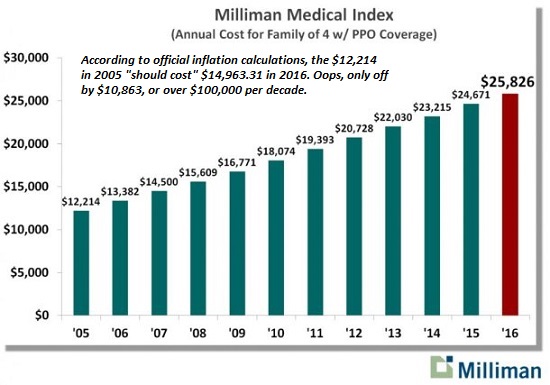
As for healthcare: feast your eyes on this chart of medical expenses.

image: http://www.oftwominds.com/photos2016/medical-costs6-16a.jpg

According to official inflation calculations, the $12,214 annual medical costs for a family of four in 2005 "should cost" around $15,000 today.

Oops—the actual cost is $25,826, $10,826 higher than official inflation, which adds over $100,000 in cash outlays above and beyond official inflation in the course of a decade.

So let's add the $30,000 per university student above and beyond inflation for two college students over a decade and the $100,000 in healthcare costs that are above and beyond inflation over that decade, and we get $160,000.

Since deductions for education and healthcare don't completely wipe out income taxes, the household has to earn close to $200,000 more over the decade to net out the $160,000 to pay typical college and healthcare costs above and beyond what education and healthcare "should cost" if inflation in big-ticket items had actually tracked official inflation.

$100,000 here, $100,000 there and pretty soon you're talking real money in a nation in which median household income is around $57,000 annually.

So if a household's income kept up with official inflation over a decade, that household would have to earn at least $20,000 more per year just to keep pace with real-world, big-ticket cost increases.

That's the problem, isn't it? If the household's wages only kept up with inflation, there isn't another $20,000 a year in additional income needed to pay these soaring big-ticket costs. So the shortfall has to be borrowed, burdening the household with debt and interest payments for decades to come, or the kids don't attend college and the household goes without healthcare insurance.

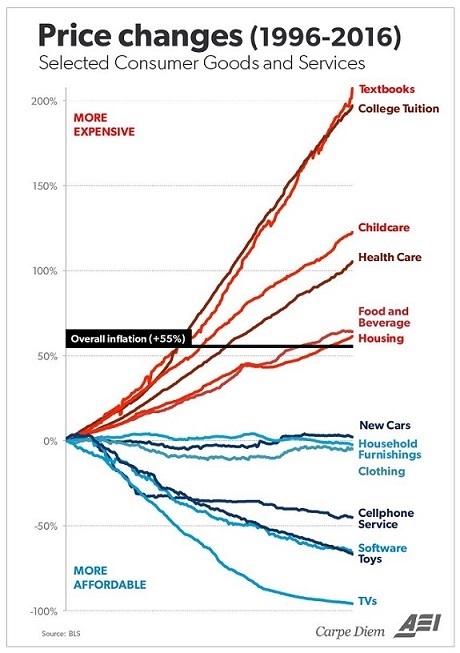
Once again, real-world costs have soared at a rate that is almost six times higher than the official rate of inflation.

The reality is real-world inflation in big-ticket essentials is crushing every household that doesn't qualify for government subsidies of higher education, rent and healthcare.

image: http://www.oftwominds.com/photos2017/inflation10-16.jpg

No wonder the political and financial Elites don't care about inflation: their incomes have soared far above mere inflation. When you're skimming millions, who cares about a mere $150,000 for a university education, or $25,000 for healthcare insurance?

Do you reckon the lobbyists for Big Pharma and the rest of the healthcare racket are spending millions lobbying politicians to slash the soaring costs of healthcare? Do you think all the universities collecting billions in government-guaranteed student loans are lobbying politicos to reduce loans to debt-serf students? Sorry, but that's not how pay-to-play "democracy" works.

In pay-to-play "democracy," the goal is to raise prices without improving service, and have the federal government enforce this racket on powerless debt-serfs.

If you want to understand why we're fragmenting as a society, start by looking at the asymmetric burdens imposed by inflation. The Elites aren't worried about inflation because they don't even feel it. And since they rule to benefit the top 5%, they don't really care what the bottom 95% are experiencing.

In other words, "Let them eat cake."

Wednesday, May 17, 2017

Ξενοφών Ζολώτας: «Αυτοί οι δύο θα χρεοκοπήσουν τη χώρα»

Ήταν 3 Ιανουαρίου 1990, αργά το βράδυ και ενώ οι διάδρομοι της Βουλής ήσαν σχεδόν άδειοι, στο γραφείο του πρωθυπουργού της οικουμενικής κυβέρνησης Καθηγητή Ξενοφώντα Ζολώτα επικρατούσε μια απίστευτη ένταση και υπερκινητικότητα. Το συμβούλιο των πολιτικών αρχηγών (Κωνστ. Μητσοτάκης, Ανδρέας Παπανδρέου, Χαρίλαος Φλωράκης - πρόεδρος Συνασπισμού της Αριστεράς) δεν ενέκρινε το έκτακτο σχέδιο 10 σημείων που πρότεινε ο κ. Καθηγητής και η χώρα κινδύνευε με άμεση χρεοκοπία και στάση πληρωμών.
 

Το ήξεραν ή το υποψιάζονταν ελάχιστοι και η καθημερινότητα στην χειμωνιάτικη Αθήνα ήταν απολύτως ομαλή παρά τις γνωστές και οικείες έντονες πολιτικές αντιπαραθέσεις. Άλλωστε παντού στον δυτικό κόσμο η πτώση του τείχους του Βερολίνου, η διάλυση του υπαρκτού σοσιαλισμού και το άνοιγμα των βόρειων συνόρων της χώρας είχαν προκαλέσει μια γενικευμένη αίσθηση αισιοδοξίας.
 
Στην Ελλάδα είχαν προηγηθεί δύο εκλογικές αναμετρήσεις με την πρώτη να οδηγεί στην συγκρότηση της κυβέρνησης Τζαννετάκη με συνεργασία ΝΔ-Συνασπισμού και η δεύτερη στην οικουμενική κυβέρνηση Ζολώτα. Ήταν μια κυβέρνηση γέφυρα που θα οδηγούσε την χώρα ομαλά στην επόμενη εκλογική αναμέτρηση μέσα όμως από ένα σχέδιο συναινετικής Εθνικής Ανασυγκρότησης που θα οδηγούσε τη χώρα σε μια νέα πορεία. Γι'αυτό ο Ζολώτας αποφάσισε ως πρωθυπουργός να συγκροτήσει την περίφημη τότε άγνωστη σήμερα Επιτροπή Αγγελόπουλου (Άγγελος Αγγελόπουλος, Καθηγητής Οικονομίας, νεανικός φίλος του Ξ. Ζολώτα, υπουργός της «Κυβέρνησης του  Βουνού» ΠΕΕΑ και της Κυβέρνησης Εθν. Ενότητας τον Οκτώβριο Δεκέμβριο 1944).
 
Στόχος του ήταν να πείσει επιτέλους όλα τα πολιτικά κόμματα να συμφωνήσουν σε ένα ελάχιστο κοινό πρόγραμμα που συμπύκνωνε την έμμονη ιδέα του Καθηγητή από το 1924, όταν έγινε - ο νεότερος στη ιστορία - Καθηγητής Οικονομικών. Νομισματική σταθερότητα μαζί με γρήγορη οικονομική ανάπτυξη και εκβιομηχάνιση. Κάτι που το κατόρθωσε προσωρινά ως διοικητής της Τράπεζας της Ελλάδας την περίοδο 1955-1967, όταν η Ελλάδα σημείωσε ποσοστά ανάπτυξης του ΑΕΠ με τον «ιαπωνικό» ρυθμό  του 6-7% ετησίως. Σε στενή συνεργασία και με την υποστήριξη του Κων. Καραμανλή που έγινε πρωθυπουργός το 1955, προώθησε ένα επιτυχημένο μείγμα κρατικής παρέμβασης και αγοράς που μόνον η Ιαπωνία και η Νότιος Κορέα κατόρθωσαν να επιτύχουν.
 
Αυτό ήταν το όραμα Ζολώτα. Βιομηχανία τύπου Νότιας Κορέας (το 1960 ήταν φτωχότερη από την Ελλάδα) δημοκρατία αναπτυγμένης χώρας και στόχευση στην καρδιά της Ευρώπης. Αν και δεν εξέφραζε ποτέ ανοικτά τις πολιτικές του προτιμήσεις και τηρούσε με θρησκευτική ευλάβεια την αμερόληπτη ουδετερότητα που του επέβαλλε η θέση του ως Διοικητή της ΤτΕ και ο δυναμικά μειλίχιος χαρακτήρας του, δεν ανήκε ποτέ στην Δεξιά Παράταξη. Ήταν πάντοτε ένας κεντρώος της σύνθεσης.
 
Έκανα αυτή την παρενθετική παρέμβαση του κεντρικού αφηγηματικού νήματος του άρθρου για τρεις λόγους. Ο πρώτος είναι η εξαιρετική έκθεση για το έργο και την ζωή του Ξενοφώντα Ζολώτα που εγκαινιάστηκε προχθές στο νέο κτίριο της Τράπεζας της Ελλάδος (ΤτΕ) στην οδό Αμερικής και θα διαρκέσει αρκετούς μήνες. Προτείνω σε όλους και ιδίως στους νεότερους που μάλλον δεν ξέρουν καν της ύπαρξή του να την επισκεφτούν. Πρόκειται για τον μεγαλύτερο Έλληνα οικονομολόγο και - για μένα - τον πιο συνειδητό Έλληνα πρωθυπουργό που προσέγγισε την έννοια του «Δημόσιου Συμφέροντος» περισσότερο από οποιονδήποτε άλλον.
 
Ο δεύτερος λόγος έχει να κάνει και αυτός με την επικαιρότητα των πιο σκληρών πλευρών της ιστορίας μας.  Με αφορμή τα 70 χρόνια από τα Δεκεμβριανά του 1944 και την συζήτηση που άνοιξε θα πρέπει να εξεταστεί και η προσπάθεια ενός τρίτου, σοσιαλιστικού και δημοκρατικού πόλου που συνετρίβη πρόωρα μέσα στην μέγγενη του εμφύλιου πολέμου που ακολούθησε. Άλλωστε ο Ξεν. Ζολώτας θεωρούσε ιδανικό οικονομικό σύστημα και για την Ελλάδα – με σταδιακά βήματα και εφόσον το επέτρεπαν οι συνθήκες – τον «Δημιουργικό Σοσιαλισμό» (βλέπε βιβλίο του με τον ίδιο τίτλο το 1943) που θα ήταν μια σύνθεση φιλελεύθερης (όχι αρρύθμιστης ή όπως λέμε σήμερα νεοφιλελεύθερης) αγοράς με ένα ισχυρό κοινωνικό κράτος και γι'αυτό μαζί με τον Άγγελο Αγγελόπουλο ίδρυσαν κατά την διάρκεια της Κατοχής το 1942 τον όμιλο Σοσιαλιστική Ένωση (στην οποία από πρόταση της Ιωάννας Τσάτσου συμμετείχε για λίγο και ο Κωνσταντίνος Καραμανλής).
 
Ο τρίτος λόγος και πιο σημαντικός ακολουθεί. Ας ξαναγυρίσουμε  λοιπόν στην αρχή της ιστορίας.
 
«Είναι καλοί άνθρωποι αλλά είναι άρπαγες του κράτους»
 
Όταν στις 23 Νοεμβρίου 1989 ο Καθηγητής Ζολώτας ανέλαβε  ύστερα από ομόφωνα πρόταση των κομμάτων την πρωθυπουργία της οικουμενικής Κυβέρνησης, τα οικονομικά στοιχεία που του δόθηκαν ήταν από ασαφή έως θολά. Σίγουρα πολύ χειρότερα απ' ότι του είχαν ειπωθεί. Είχε προηγηθεί η τρίμηνη θητεία της κυβέρνησης Τζαννετάκη, ένα καθεστώς ημικυβερνησίας. Υπουργός Οικονομικών ήταν ο Αντ. Σαμαράς με βασική καινοτομία της υπουργίας του την εισαγωγή των αφορολόγητων κόκκινων πινακίδων αυτοκινήτων ΑΜΟ που πλημμύρισαν τη χώρα, παρότι προορίζονταν αρχικά για τους εργαζόμενους στο εξωτερικό (βλ άρθρο ΑΔ Παπαγιαννίδη στον Οικ. Ταχυδρόμο Σεπτ 1999). Μεταπήδησε στην συνέχεια και στην οικουμενική ως υπουργός Εξωτερικών. Την ίδια θέση διατήρησε και στην κυβέρνηση Μητσοτάκη που ήλθε στην εξουσία τον Απρίλιο του 1990, όταν έγινε ο «μοιραίος» άνθρωπος για την εμπλοκή στο Σκοπιανό αλλά και για την πτώση της κυβέρνησης της ΝΔ το 1993. Και μετά ήλθε πάλι στην εξουσία ο ΑΓ Παπανδρέου και πάλι τα γνωστά. Στην Ελλάδα ένας κλειστός αριθμός ατόμων επανέρχονται εναλλάξ στην εξουσία.
 
Γενικά η κυβέρνηση Τζαννετάκη - όπως και όλες οι προηγουμένως -  δεν παρέδωσε τίποτα. Όταν ο πρωθυπουργός μου ζήτησε να βρω τα αρχεία αποφάσεων και ομιλιών για να τα συμβουλευτεί, οι δέκα, προϋπάρχουσες, κυρίες γραμματείς του Γραφείου Τύπου του Πρωθυπουργού - «τρελάθηκα» με τον αριθμό - με κοίταξαν με απορία. «Ποια αρχεία, δεν υπάρχουν αρχεία» μου είπε η προϊσταμένη. «Τα παίρνουν όλα οι Πρωθυπουργοί στο σπίτι τους». Τρελάθηκα για δεύτερη φορά αλλά όπως αποδείχτηκε ήμουν απλά στον πρόλογο. (Τελικά το 2002 ψηφίσθηκε νόμος για τα Αρχεία του Πρωθυπουργού με πρωτοβουλία του καθηγητή Γιώργου Παπαδημητρίου, νομικού συμβούλου επί πρωθυπουργίας Κώστα Σημίτη, αλλά μάλλον δεν εφαρμόζεται πλήρως ακόμη. Ίσως το 2050). Όταν  μετέφερα το νέο στον Καθηγητή Ζολώτα, παρότι τυπικά το θέμα ήταν ήσσονος σημασίας για την εποχή, εξερράγη. «Είμαι 86 ετών. Έχω γράψει  40 βιβλία αλλά μόνο τώρα αρχίζω να καταλαβαίνω τις βαθιές παθογένειες της χώρας. Είναι θαύμα που επιβιώνει αυτό το κράτος» Και ήταν μόνο  η αρχή.
 
Στις 3 Ιανουαρίου του 1990 η κατάσταση στα δημοσιονομικά πράγματα έτεινε να γίνει απελπιστική. Το ΑΕΠ της χώρας σε ευρώ ήταν περίπου στα 70 δις (σήμερα είναι 184 δις) ενώ το Δημόσιο χρέος ακόμη ήταν μόνο στο 70% με ραγδαία όμως αυξητική τάση (σήμερα είναι ως γνωστόν στο 176% του ΑΕΠ). Ο πληθωρισμός γύρω στο 15% (σήμερα έχουμε αρνητικό πληθωρισμό ή αποπληθωρισμό) τα επιτόκια εσωτερικού στο 24% το δημόσιο έλλειμμα κτύπαγε το 13% (όπως το 2009) και περίπου στο 10-12% ήταν το έλλειμμα του εξωτερικού ισοζυγίου πληρωμών. Είχαν αρχίσει σταδιακά εξαγωγές κεφαλαίων με ταξίδια στην Ελβετία κα το κυριότερο κινδυνεύαμε με αθέτηση  διεθνών πληρωμών και με μη πληρωμή μισθών και συντάξεων. Ουσιαστικά υπήρχε διορία 2 ή 3 ήμερών πριν το πρόβλημα πάρει μεγάλες διαστάσεις και υπήρχε ο άμεσος κίνδυνος γενικευμένης ανησυχίας των πολιτών για την «υγεία» και την ισοτιμία της δραχμής. (Αποκτήσαμε τελικά το 2001 το ευρώ αλλά ήδη είχαν ξεπροβάλλει τα τρία περίφημα κριτήρια του Μάαστριχτ που θεσπίστηκαν το 1993.)
 
Με δεδομένη την άρνηση των τριών πολιτικών αρχηγών να συναινέσουν στα 10 έκτακτα μέτρα Ζολώτα, το μόνο που έμενε ήταν η έκτακτη σύναψη Syndicated Loan από Διεθνείς Τράπεζες (η αγορά Ομολόγων δεν ήταν τότε πολύ αναπτυγμένη). Πράγμα ιδιαιτέρως δύσκολο να πραγματοποιηθεί σε ένα λογικό και μη αστρονομικό επιτόκιο.
 
Όταν μπήκα στο γραφείo του καθηγητή Ζολώτα στο ισόγειο της Βουλής, τον είδα για μια και μόνη φορά στην 18χρονης γνωριμίας μας (τον γνώρισα το 1986 όταν έκανα μαζί του μια συνέντευξη εφ'όλης της ύλης για τα 70 χρόνια του ΟΙΚΟΝΟΜΙΚΟΥ ΤΑΧΥΔΡΟΜΟΥ) να κάθεται «σε αναμμένα κάρβουνα».  Είχε μπροστά του δυο μεγάλα καλογραμμένα λογιστικά φύλλα κάτι σαν έσοδα - έξοδα υποχρεώσεις του κράτους και δίπλα κράταγε σημειώσεις με συνεχείς αναπροσαρμογές. Είχε έρθει για δεύτερη φορά ένας παλιός μαθητής του από το Γενικό Λογιστήριο του Κράτους με άλλα δυο λογιστικά τεφτέρια υπό μάλης. Τηλεφώνησε στον από χρόνια στενότερο συνεργάτη του Ν.Α. από την Τράπεζα της Ελλάδας «Μόνο σε αυτούς του δύο έχω εμπιστοσύνη για την αξιοπιστία των στοιχείων. Είναι οι μόνοι που δεν μου πασάρουν "αλλοιωμένα" στοιχεία για τις πραγματικές υποχρεώσεις του κράτους». «Μα κύριε Καθηγητά του αντέτεινα αυτά δεν είναι επίσημα στοιχεία. Είστε Πρωθυπουργός της χώρας θα έπρεπε να είχατε σε πέντε λεπτά τα πραγματικά μεγέθη του Κράτους».
 
«Παιδί μου, είπε (προσφιλής προσφώνηση του Καθηγητή στους στενούς του συνεργάτες ανεξαρτήτως ηλικίας) δεν υπάρχει πλέον ενιαίο κράτος στην Ελλάδα. Το κράτος είναι κάτι σαν αδειανό πουκάμισο για τα μάτια του κόσμου. Γνωρίζω από παλιά τον Ανδρέα και τον Μητσοτάκη και είναι καλοί άνθρωποι ως άτομα. Αλλά με τα κόμματά τους έχουν γίνει άρπαγες του κράτους που το λαφυραγωγούν εναλλάξ. Έχουν φτιάξει δύο παράλληλους κομματικούς μηχανισμούς υποκαθιστώντας το επίσημο κράτος. Συγκρούονται αδυσώπητα αλλά ξέρουν ότι είναι μια ο ένας μια ο άλλος. Και κρατάνε τις κρίσιμες πληροφορίες μόνο για τον εαυτό τους.  Οι της ΝΔ δραματοποιούν τα στοιχεία προς το χειρότερο γιατί θέλουν άμεσα εκλογές, οι του ΠΑΣΟΚ κάνουν το ακριβώς αντίθετο γιατί δεν θέλουν τώρα εκλογές και είναι ικανοί μέσα στην αδιάφορη ανευθυνότητά τους να καταγγέλλουν ο ένας τον άλλο δημοσίως και να εκθέτουν τη χώρα διεθνώς. Να το θυμάσαι ότι αυτό οι δύο σε πέντε σε δέκα ίσως και λίγο περισσότερα χρόνια θα χρεοκοπήσουν την Ελλάδα».
 
«Το δράμα», συνέχισε «η τραγωδία είναι ότι αυτός που είναι ο πιο λογικός αυτός που με στηρίζει περισσότερο στο Συμβούλιο Αρχηγών που είναι αυτός που έχουμε τις μεγαλύτερες διαφορές. Ο Χαρίλαος Φλωράκης ίσως επειδή έζησε την άγρια εποχή του εμφύλιου δείχνει την μεγαλύτερη ευαισθησία για την κρισιμότητα της κατάστασης. Αλλά και αυτός δεν μπορεί να τα πει δημοσίως. Τις προάλλες μου είπε: «Ξενοφώντα αν σε στηρίξω δημοσίως θα με φάνε οι δικοί μου». Ίσως τελικά να μας σώσει η Ευρώπη με τις νέες Συνθήκες αλλά με διαλυμένο και αρπακτικό κράτος η ιδιωτική οικονομία θα μείνει απροστάτευτη και θα καταστραφεί μέσα στον θυελλώδη ανταγωνισμό».
 
Συγκρουσιακή λαφυραγώγηση εναλλάξ και ΜΝΗΜΟΝΙΟ
 
Σοφά, προφητικά λόγια ενός ΜΟΝΑΔΙΚΟΥ  Έλληνα που δυστυχώς αποδείχτηκαν στο σύνολο τους αληθινά. Δεκατέσσερα χρόνια μετά, το 2004 ο Γ. Αλογοσκούφης καταγγέλλει ως υπουργός Οικονομικών της κυβέρνησης Κώστα Καραμανλή την προηγούμενη κυβέρνηση του ΠΑΣΟΚ ότι έκρυβε ελλείμματα κάτω από το χαλί. Πρώτη διεθνής δυσφήμηση της χώρας. Το 2009 ο Γιώργος Παπακωνσταντίνου ως υπουργός Οικονομικών της κυβέρνησης Γιώργου Παπανδρέου καταγγέλλει τον Γ Αλογοσκούφη (και  Γ Παπαθανασίου) ότι και αυτοί με την σειρά τους έκρυβαν το κολοσσιαία δημόσιο έλλειμμα στο 13,5% του ΑΕΠ. Τα στοιχεία ήσαν αληθινά αλλά πρέπει να δούμε τον «φαύλο κύκλο» και των δυο μαζί στο ίδιο πλαίσιο. Είναι οι δυο όψεις της ίδιας συγκρουσιακής λαφυραγώγησης του κράτους εναλλάξ που έλεγε κι ο καθηγητής Ζολώτας. Δεύτερη διεθνής δυσφήμηση της χώρας. Μετά πανικός, μερική χρεοκοπία, αποκλεισμός από τις αγορές, ΜΝΗΜΟΝΙΟ. Όσοι έζησαν από κοντά και μέσα στο εσωτερικό της τότε κεντρικής εξουσίας περιγράφουν μια εικόνα απίστευτης σύγχυσης, πρωτοφανούς ερασιτεχνισμού και τσαπατσουλιάς και δυστυχώς δεν υπήρχε ένας Ζολώτας με μαεστρικές κινήσεις να σώσει την χώρα όπως το έκανε το 1990.
 
Ο Α Σαμαράς και η ΝΔ ήταν κατά του Μνημονίου μέχρι το 2012. Μετά ανέλαβε την εξουσία μαζί με το ΠΑΣΟΚ και έγινε υπέρ αναφανδόν. Συνεχίσθηκε η ίδια παράλογη υφεσιακή περιοριστική πολιτική σε καθεστώς αποπληθωρισμού που στραγγάλισε την ιδιωτική οικονομία και η οποία είναι ομόρροπη μόνο με τα βραχυπρόθεσμα συμφέροντά της Γερμανίας και των χωρών του Βορρά. Ακολούθησαν θυελλώδεις, σπασμωδικές δήθεν «αλλαγές», μαζική περικοπή εισοδημάτων και υπερφορολόγηση που αφορούσαν μόνον τους «πολλούς άλλους», αλλά όχι το κομματικό τους δυναμικό μαζί με τις οικογένειές τους. Σύμφωνα με ορισμένες αδημοσίευτες έρευνες, το ποσοστό ανεργίας τους ανέρχεται μόνο στο 4-5% ενώ το συνολικό είναι 27%.
 
Αυτό φαίνεται λογικό γιατί ΝΔ και ΠΑΣΟΚ (περίπου 6000 στελέχη και 150.000 μέλη) έχουν γίνει τα τελευταία 20 χρόνια αποκλειστικοί «ιδιοκτήτες» του ελληνικού κράτους.  Έχουν «αποικιοποιήσει» το κράτος.  Σε συνδυασμό με προσωρινά ευνοϊκές γι αυτούς ευρωπαϊκές συμμαχίες και μαζί με το 20% των πιο πλούσιων Ελλήνων που έχουν πληγεί λίγο η καθόλου από την κρίση είχαν συγκροτήσει ένα σκληρό μπλοκ εξουσίας που μοιάζει με στάσιμη ολιγαρχία και ελέγχει το σύνολο σχεδόν των επικοινωνιακών διαύλων της χώρας. Αποτελούν ένα είδος «vested interests» (καθεστωτικά συμφέροντα) που υπονομεύουν την παραγωγικότητα του κράτους, την κοινωνική κινητικότητα και την επιχειρηματική ανανέωση. Γιατί να δουλέψει κάποιος περισσότερο και πιο παραγωγικά όταν ξέρει ότι ο κομματικός θα πάρει όλα τα εύσημα  και τις θέσεις έτσι κι αλλιώς; Γιατί να δεχτεί κάποιος αξιολόγηση όταν ξέρει ότι την αξιολόγηση την ελέγχει ο μηχανισμός ΝΔ - ΠΑΣΟΚ;
 
Η Ελληνική Δημοκρατία που δημιουργήθηκε με τόσες προσδοκίες το 1974 πρέπει να βρει με άψογες δημοκρατικές και κοινοβουλευτικές διαδικασίες ένα τρόπο να απελευθερώσει το Ελληνικό κράτος από την «αποκλειστική ιδιοκτησία» τους προσπαθώντας επιτέλους να του δώσει δίκαιες «απρόσωπες» δομές σε κοινό κτήμα έτσι ώστε κανένας να μην μπορεί να γίνει μόνιμα αποκλειστικός κυρίαρχος. Ένα σύγχρονο δημοκρατικό κράτος στην καρδιά του πρέπει να παραμένει πάντοτε ένας «κενός χώρος» με προσωρινή καθοδήγηση αυτών που επιλέγουν οι πολίτες. Χωρίς να είναι ιδιοκτησία κανενός. Αυτή είναι η μία και μόνη κεφαλαιώδης «Διαρθρωτική Αλλαγή» η  πιο σημαντική μεταρρύθμιση που πρέπει να γίνει και είναι πολύ πιο σημαντική από οποιαδήποτε εργαλειοθήκη του ΟΟΣΑ για τις επιμέρους αγορές ή την ασφαλιστική μεταρρύθμιση των ταμείων.
 
Για να κλείσουμε εαυτό το μακροσκελές και βιωματικό άρθρο που είναι αφιερωμένο στα 10 χρόνια από το θάνατο του Καθηγητή Ζολώτα (πέθανε πλήρης ημερών το 2004 σε ηλικία 100 ετών) να πούμε ότι την 3 Ιανουαρίου 1990 μέσα σε λίγες ώρες με απανωτές, συντονισμένες κινήσεις ο πρωθυπουργός Ζολώτας έσωσε την χώρα από μια άτακτη   χρεοκοπία. Με τηλεφωνικές επικοινωνίες με 3 κεντρικούς τραπεζίτες, τον Ζακ Ντελόρ, τον Μίνω Ζομπανάκη και ιδίως με τον τότε Διοικητή της ΤτΕ Γ. Χαλικιά για την αποτροπή οποιασδήποτε ανησυχίας του κοινού για την δραχμή και την κινητοποίηση του προσωπικού με εποπτεία των τραπεζών (τότε δεν υπήρχαν online συστήματα και πολλά ΑΤΜ) και ιδίως  με την σύναψη δολλαριακού δάνειου με το υψηλό επιτόκιο 10,4% (πληρώσαμε παραπάνω αλλά σώθηκε προσωρινά η χώρα) η απειλή χρεοκοπίας απεχώρησε από το προσκήνιο.
 
Οι εκλογές έγιναν ομαλά στις 8 Απριλίου 1990 και εξελέγη πρωθυπουργός ο Κων Μητσοτάκης. Εκείνη την ημέρα αφού ψήφισε στο εκλογικό κέντρο κοντά στην Διονυσίου Αρεοπαγίτου κάτσαμε σε ένα καφενεδάκι για έναν ήρεμο καφέ. Ήταν εύθυμος, σφύριζε με τον δικό του μελωδικό σκοπό, κάπνισε το καθιερωμένο τσιγάρο Benson Royal των 100 εκατοστών με τον καφέ - χωρίς ποτέ να κατεβάζει τον καπνό - σχολίαζε και συζήταγε με δεκάδες θαμώνες που του μιλούσαν με σεβασμό. Ήταν 87 ετών και ένιωθε πενηντάρης. «Έκανα το καθήκον μου και παρέδωσα την χώρα χωρίς κανένα επιπλέον πρόβλημα. Θα μπορούσα να κάνω πολλά ακόμη αν με άφηναν και αν είχα χρόνο. Αλλά αυτός ο Μητσοτάκης βιαζότανε να πάρει την εξουσία και απέσυρε τους υπουργούς του πρόωρα. Τι να κάνουμε αυτά έχει η ζωή και  η πολιτική. Αλλά μην ξεχάσεις ότι σου είπα την πρώτη ημέρα που σε διόρισα στο γραφείο μου. Ό,τι είδες, ό,τι ακούσεις, ό,τι σου είπα θα τα ξεχάσεις. Τουλάχιστον για 20 χρόνια. Έως τότε θα έχουμε ίσως διορθωθεί και άλλωστε μάλλον και οι τέσσερις μας στο Συμβούλιο Πολιτικών Αρχηγών θα έχουμε αποδημήσει εις Κύριον».
 
Μόνο μια αστοχία πρόβλεψης. Ο Κων. Μητσοτάκης ζει και βασιλεύει κα είναι πλέον ο μόνος εν ζωή πολύπειρος πρώην πρωθυπουργός. Λίγα χρόνια μετά  ρώτησα τον Κων. Μητσοτάκη ποια είναι η γνώμη του για τον Ξενοφώντα Ζολώτα. «Ο Ξενοφών Ζολώτας είναι ένας πεπεισμένος κρατιστής. Γι'αυτό διαφωνούσαμε τόσο συχνά». Ναι αλλά τι είδους κρατιστής; ¨Ένα τέτοιο δημιουργικό κρατιστή με μετριοπαθείς φιλελεύθερες απόψεις και πίστη στον δημιουργικό Σοσιαλισμό που συνδυάζει το κράτος με την αγορά και την επιχειρηματική καινοτομία μάλλον χρειάζεται ακόμη και σήμερα η χώρα, 110 χρόνια μετά τη γέννησή του.
 
Περικλής Βασιλόπουλος
 
Δημοσιογράφος, Αντιπρόεδρος της Ένωσης Πολιτών για την ΠΑΡΕΜΒΑΣΗ. Διατέλεσε Διευθυντής του Γραφείου Τύπου του Πρωθυπουργού στην Οικουμενική Κυβέρνηση Ζολώτα (1989-90)

Thursday, March 30, 2017

Η ΔΗΜΟΚΡΑΤΙΑ ΤΟΥ ΕΦΙΑΛΤΗ


Το 462 π.Χ. είναι μια ξεχωριστή στιγμή στην ιστορία της ανθρωπότητας. Το έτος αυτό γεννήθηκε η ΔΗΜΟΚΡΑΤΙΑ, τόσο σαν πολίτευμα, όσο και σαν λέξη.
Στο πολίτευμα της δημοκρατίας που εγκαθίδρυσε ο Εφιάλτης, η πολιτική εξουσία ανατέθηκε στους ίδιους τους πολίτες, ώστε να την ασκούν αυτοπροσώπως και όχι μέσω αντιπροσώπων τους. Ονομάστηκε δημοκρατία για να εκφράσει το πολίτευμα κατά τρόπο αυθεντικό, γιατί ακριβώς η λέξη σημαίνει: "εξουσία των πολιτών".
Η δημοκρατία λειτούργησε επί εκατόν σαράντα χρόνια (462 - 322 π.Χ.) και άφησε ολόκληρο τον κόσμο κατάπληκτο, όχι μόνο με τον ανεπανάληπτο πολιτισμό που δημιούργησε, αλλά, κυρίως, γιατί ανύψωσε τον απλό πολίτη σε ό,τι πιο υπεύθυνο και ελεύθερο, με συνείδηση της μοναδικής αξίας της ανθρώπινης προσωπικότητας.
Όταν μιλάμε για δημοκρατία και θέλουμε η λέξη να ανταποκρίνεται στα πράγματα, πρέπει να αναφερόμαστε μόνο στην περίοδο που λειτούργησε στην Αθήνα (462 - 322 π.Χ.).
Σήμερα παρουσιάζονται ως δημοκρατικά, καθεστώτα που δεν έχουν καμιά συγγένεια με τη δημοκρατία. Στο όνομα της δημοκρατίας, οι κυρίαρχες δυνάμεις, καταδυναστεύουν τους λαούς σε όλα τα πλάτη και τα μήκη της γης. (Από την παρουσίαση στο οπισθόφυλλο του βιβλίου)


Sunday, August 28, 2016

Mythbusting 101: Organic Farming > Conventional Agriculture

Mythbusting 101: Organic Farming > Conventional Agriculture
By Christie Wilcox on July 18, 2011


People believe a lot of things that we have little to no evidence for, like that vikings wore horned helmets or that you can see the Great Wall of China from space. One of the things I like to do on my blogs is bust commonly held myths that I think matter. For example, I get really annoyed when I hear someone say sharks don't get cancer (I'll save that rant for another day). From now onward, posts that attack conventionally believed untruths will fall under a series I'm going to call "Mythbusting 101."

Ten years ago, Certified Organic didn't exist in the United States. Yet in 2010, a mere eight years after USDA's regulations officially went into effect, organic foods and beverages made $26.7 billion. In the past year or two, certified organic sales have jumped toabout $52 billion worldwide despite the fact that organic foods cost up to three times as much as those produced by conventional methods. More and more, people are shelling out their hard-earned cash for what they believe are the best foods available. Imagine, people say: you can improve your nutrition while helping save the planet from the evils of conventional agriculture - a completewin-win. And who wouldn't buy organic, when it just sounds so good?

Here's the thing: there are a lot of myths out there about organic foods, and a lot of propaganda supporting methods that are rarely understood. It's like your mother used to say: just because everyone is jumping off a bridge doesn't mean you should do it, too. Now, before I get yelled at too much, let me state unequivocally that I'm not saying organic farming is bad - far from it. There are some definite upsides and benefits that come from many organic farming methods. For example, the efforts of organic farmers to move away from monocultures, where crops are farmed in single-species plots, are fantastic; crop rotations and mixed planting are much better for the soil and environment. My goal in this post isn't to bash organic farms, instead, it's to bust the worst of the myths that surround them so that everyone can judge organic farming based on facts. In particular, there are four myths thrown around like they're real that just drive me crazy.

Myth #1: Organic Farms Don't Use Pesticides

When the Soil Association, a major organic accreditation body in the UK, asked consumers why they buy organic food, 95% of them said their top reason was to avoid pesticides. They, like many people, believe that organic farming involves little to no pesticide use. I hate to burst the bubble, but that's simply not true. Organic farming, just like other forms of agriculture, still uses pesticides and fungicides to prevent critters from destroying their crops. Confused?

So was I, when I first learned this from a guy I was dating. His family owns a farm in rural Ohio. He was grumbling about how everyone praised the local organic farms for being so environmentally-conscientious, even though they sprayed their crops with pesticides all the time while his family farm got no credit for being pesticide-free (they're not organic because they use a non-organic herbicide once a year). I didn't believe him at first, so I looked into it: turns out that there are over 20 chemicals commonly used in the growing and processing of organic crops that are approved by the US Organic Standards. And, shockingly, the actual volume usage of pesticides on organic farms is not recorded by the government. Why the government isn't keeping watch on organic pesticide and fungicide use is a damn good question, especially considering that many organic pesticides that are also used by conventional farmers are used more intensively than synthetic ones due to their lower levels of effectiveness. According to theNational Center for Food and Agricultural Policy, the top two organic fungicides, copper and sulfur, were used at a rate of 4 and 34 pounds per acre in 1971 1. In contrast, the synthetic fungicides only required a rate of 1.6 lbs per acre, less than half the amount of the organic alternatives.

The sad truth is, factory farming is factory farming, whether its organic or conventional. Many large organic farms use pesticides liberally. They're organic by certification, but you'd never know it if you saw their farming practices. As Michael Pollan, best-selling book author and organic supporter, said in an interview with Organic Gardening,

"They're organic by the letter, not organic in spirit... if most organic consumers went to those places, they would feel they were getting ripped off."

What makes organic farming different, then? It's not the use of pesticides, it's the origin of the pesticides used. Organic pesticides are those that are derived from natural sources and processed lightly if at all before use. This is different than the current pesticides used by conventional agriculture, which are generally synthetic. It has been assumed for years that pesticides that occur naturally (in certain plants, for example) are somehow better for us and the environment than those that have been created by man. As more research is done into their toxicity, however, this simply isn't true, either. Many natural pesticides have been found to be potential - or serious - health risks.2

Take the example of Rotenone. Rotenone was widely used in the US as an organic pesticide for decades 3. Because it is natural in origin, occurring in the roots and stems of a small number of subtropical plants, it was considered "safe" as well as "organic". However, research has shown that rotenone is highly dangerous because it kills by attacking mitochondria, the energy powerhouses of all living cells. Research found that exposure to rotenone caused Parkinson's Disease-like symptoms in rats 4, and had the potential to kill many species, including humans. Rotenone's use as a pesticide has already been discontinued in the US as of 2005 due to health concerns***, but shockingly, it's still poured into our waters every year by fisheries management officials as a piscicide to remove unwanted fish species.

The point I'm driving home here is that just because something is natural doesn't make it non-toxic or safe. Many bacteria, fungi and plants produce poisons, toxins and chemicals that you definitely wouldn't want sprayed on your food.

Just last year, nearly half of the pesticides that are currently approved for use by organic farmers in Europe failed to pass the European Union's safety evaluation that is required by law 5. Among the chemicals failing the test was rotenone, as it had yet to be banned in Europe. Furthermore, just over 1% of organic foodstuffs produced in 2007 and tested by the European Food Safety Authority were found to contain pesticide levels above the legal maximum levels - and these are of pesticides that are not organic 6. Similarly, when Consumer Reports purchased a thousand pounds of tomatoes, peaches, green bell peppers, and apples in five cities and tested them for more than 300 synthetic pesticides, they found traces of them in 25% of the organically-labeled foods, but between all of the organic and non-organic foods tested, only one sample of each exceeded the federal limits8.

Not only are organic pesticides not safe, they might actually be worse than the ones used by the conventional agriculture industry. Canadian scientists pitted 'reduced-risk' organic and synthetic pesticides against each other in controlling a problematic pest, the soybean aphid. They found that not only were the synthetic pesticides more effective means of control, the organic pesticides were more ecologically damaging, including causing higher mortality in other, non-target species like the aphid's predators9. Of course, some organic pesticides may fare better than these ones did in similar head-to-head tests, but studies like this one reveal that the assumption that natural is better for the environment could be very dangerous.

Even if the organic food you're eating is from a farm which uses little to no pesticides at all, there is another problem: getting rid of pesticides doesn't mean your food is free from harmful things. Between 1990 and 2001, over 10,000 people fell ill due to foods contaminated with pathogens like E. coli, and many have organic foods to blame. That's because organic foods tend to have higher levels of potential pathogens. One study, for example, found E. coli in produce from almost 10% of organic farms samples, but only 2% of conventional ones10. The same study also found Salmonella only in samples from organic farms, though at a low prevalence rate. The reason for the higher pathogen prevalence is likely due to the use of manure instead of artificial fertilizers, as many pathogens are spread through fecal contamination. Conventional farms often use manure, too, but they use irradiation and a full array of non-organic anti-microbial agents as well, and without those, organic foods run a higher risk of containing something that will make a person sick.

In the end, it really depends on exactly what methods are used by crop producers. Both organic and conventional farms vary widely in this respect. Some conventional farms use no pesticides. Some organic farms spray their crops twice a month. Of course, some conventional farms spray just as frequently, if not more so, and some organic farms use no pesticides whatsoever. To really know what you're in for, it's best if you know your source, and a great way to do that is to buy locally. Talk to the person behind the crop stand, and actually ask them what their methods are if you want to be sure of what you're eating.


Myth #2: Organic Foods are Healthier

Some people believe that by not using manufactured chemicals or genetically modified organisms, organic farming produces more nutritious food. However, science simply cannot find any evidence that organic foods are in any way healthier than non-organic ones - and scientists have been comparing the two for over 50 years.

Just recently, an independent research project in the UK systematically reviewed the 162 articles on organic versus non-organic crops published in peer-reviewed journals between 1958 and 2008 11. These contained a total of 3558 comparisons of content of nutrients and other substances in organically and conventionally produced foods. They found absolutely no evidence for any differences in content of over 15 different nutrients including vitamin C, ?-carotene, and calcium. There were some differences, though; conventional crops had higher nitrogen levels, while organic ones had higher phosphorus and acidity - none of which factor in much to nutritional quality. Further analysis of similar studies on livestock products like meat, dairy, and eggs also found few differences in nutritional content. Organic foods did, however, have higher levels of overall fats, particularly trans fats. So if anything, the organic livestock products were found to be worse for us (though, to be fair, barely).

"This is great news for consumers. It proves that the 98% of food we consume, which is produced by technologically advanced agriculture, is equally nutritious to the less than 2% derived from what is commonly referred to as the 'organic' market," said Fredhelm Schmider, the Director General of the European Crop Protection Association said in a press release about the findings.12

Joseph D. Rosen, emeritus professor of food toxicology at Rutgers, puts it even more strongly. "Any consumers who buy organic food because they believe that it contains more healthful nutrients than conventional food are wasting their money," he writes in a comprehensive review of organic nutritional claims13.

Strong organic proponents also argue that organic food tastes better. In the same poll where 95% of UK organic consumers said they buy organic to avoid pesticides, over two-thirds of respondents said organic produce and meats taste better than non-organic ones. But when researchers had people put their mouths to the test, they found that people couldn't tell the difference between the two in blind taste tests14, 18.

So, in short, organics are not better for us and we can't tell the difference between them and non-organic foods. There may be many things that are good about organic farming, from increased biodiversity on farms to movement away from monocultures, but producing foods that are healthier and tastier simply isn't one of them.

Myth #3: Organic Farming Is Better For The Environment

As an ecologist by training, this myth bothers me the most of all three. People seem to believe they're doing the world a favor by eating organic. The simple fact is that they're not - at least the issue is not that cut and dry.

Yes, organic farming practices use less synthetic pesticides which have been found to be ecologically damaging. But factory organic farms use their own barrage of chemicals that are still ecologically damaging, and refuse to endorse technologies that might reduce or eliminate the use of these all together. Take, for example, organic farming's adamant stance against genetically modified organisms (GMOs).

GMOs have the potential to up crop yields, increase nutritious value, and generally improve farming practices while reducing synthetic chemical use - which is exactly what organic farming seeks to do. As we speak, there are sweet potatoes are being engineered to be resistant to a virus that currently decimates the African harvest every year, which could feed millions in some of the poorest nations in the world15. Scientists have created carrots high in calcium to fight osteoperosis, and tomatoes high in antioxidants. Almost as important as what we can put into a plant is what we can take out; potatoes are being modified so that they do not produce high concentrations of toxic glycoalkaloids, and nuts are being engineered to lack the proteins which cause allergic reactions in most people. Perhaps even more amazingly, bananas are being engineered to produce vaccines against hepatitis B, allowing vaccination to occur where its otherwise too expensive or difficult to be administered. The benefits these plants could provide to human beings all over the planet are astronomical.

Yet organic proponents refuse to even give GMOs a chance, even to the point of hypocrisy. For example, organic farmers apply Bacillus thuringiensis (Bt) toxin (a small insecticidal protein from soil bacteria) unabashedly across their crops every year, as they have for decades. It's one of the most widely used organic pesticides by organic farmers. Yet when genetic engineering is used to place the gene encoding the Bt toxin into a plant's genome, the resulting GM plants are vilified by the very people willing to liberally spray the exact same toxin that the gene encodes for over the exact same species of plant. Ecologically, the GMO is a far better solution, as it reduces the amount of toxin being used and thus leeching into the surrounding landscape and waterways. Other GMOs have similar goals, like making food plants flood-tolerant so occasional flooding can replace herbicide use as a means of killing weeds. If the goal is protect the environment, why not incorporate the newest technologies which help us do so?

But the real reason organic farming isn't more green than conventional is that while it might be better for local environments on the small scale, organic farms produce far less food per unit land than conventional ones. Organic farms produce around 80% that what the same size conventional farm produces16(some studies place organic yields below 50% those of conventional farms!).

Right now, roughly 800 million people suffer from hunger and malnutrition, and about 16 million of those will die from it17. If we were to switch to entirely organic farming, the number of people suffering would jump by 1.3 billion, assuming we use the same amount of land that we're using now. Unfortunately, what's far more likely is that switches to organic farming will result in the creation of new farms via the destruction of currently untouched habitats, thus plowing over the little wild habitat left for many threatened and endangered species.

Already, we have cleared more than 35% of the Earth's ice-free land surface for agriculture, an area 60 times larger than the combined area of all the world's cities and suburbs. Since the last ice age, nothing has been more disruptive to the planet's ecosystem and its inhabitants than agriculture. What will happen to what's left of our planet's wildlife habitats if we need to mow down another 20% or more of the world's ice-free land to accommodate for organic methods?

The unfortunate truth is that until organic farming can rival the production output of conventional farming, its ecological cost due to the need for space is devastating. As bad as any of the pesticides and fertilizers polluting the world's waterways from conventional agriculture are, it's a far better ecological situation than destroying those key habitats altogether. That's not to say that there's no hope for organic farming; better technology could overcome the production gap, allowing organic methods to produce on par with conventional agriculture. If that does occur, then organic agriculture becomes a lot more ecologically sustainable. On the small scale, particularly in areas where food surpluses already occur, organic farming could be beneficial, but presuming it's the end all be all of sustainable agriculture is a mistake.

Myth #4: It's all or none

The point of this piece isn't to vilify organic farming; it's merely to point out that it's not as black and white as it looks. Organic farming does have many potential upsides, and may indeed be the better way to go in the long run, but it really depends on technology and what we discover and learn in the future. Until organic farming can produce crops on par in terms of volume with conventional methods, it cannot be considered a viable option for the majority of the world. Nutritionally speaking, organic food is more like a brand name or luxury item. It's great if you can afford the higher price and want to have it, but it's not a panacea. You would improve your nutritional intake far more by eating a larger volume of fruits and vegetables than by eating organic ones instead of conventionally produced ones.

What bothers me most, however, is that both sides of the organic debate spend millions in press and advertising to attack each other instead of looking for a resolution. Organic supporters tend to vilify new technologies, while conventional supporters insist that chemicals and massive production monocultures are the only way to go. This simply strikes me as absurd. Synthetic doesn't necessarily mean bad for the environment. Just look at technological advances in creating biodegradable products; sometimes, we can use our knowledge and intelligence to create things that are both useful, cheap (enough) and ecologically responsible, as crazy as that idea may sound.

I also firmly believe that increasing the chemicals used in agriculture to support insanely over-harvested monocultures will never lead to ecological improvement. In my mind, the ideal future will merge conventional and organic methods, using GMOs and/or other new technologies to reduce pesticide use while increasing the bioavailability of soils, crop yield, nutritional quality and biodiversity in agricultural lands. New technology isn't the enemy of organic farming; it should be its strongest ally.

As far as I'm concerned, the biggest myth when it comes to organic farming is that you have to choose sides. Guess what? You don't. You can appreciate the upsides of rotating crops and how GMOs might improve output and nutrition. You, the wise and intelligent consumer, don't have to buy into either side's propaganda and polarize to one end or another. You can, instead, be somewhere along the spectrum, and encourage both ends to listen up and work together to improve our global food resources and act sustainably.

 
See more on this, in response to critiques: In the immortal words of Tom Petty: "I won't back down"

More Mythbusting 101:

Sharks will cure cancer

*** Oh, it turns out Rotenone got re-approved for organic use in 2010. See for yourself.

Regarding the use of GMOs: perhaps Andy Revkin from The New York Times says it better.

Based on the responses, I just want to make this clear: this is NOT a comprehensive comparison of organic and conventional agriculture, nor is it intended to be. That post would be miles long and far more complex. My overall belief is that there shouldn't be a dichotomy in the first place - there are a variety of methods and practices that a farmer can use, each with its pros and cons. The main point here is that something "organic" isn't intrinsically better than something that isn't, and that you have to approach all kinds of agriculture critically to achieve optimum sustainability.

Ok, and while I'm adding in notes: stop citing Bedgley et al. 2007 as evidence that organic farming produces equal yields: this study has been shown to be flawed (see my comments in the follow up post to this article), and was strongly critiqued (e.g. this response article).

 
References

National Center for Food and Agricultural Policy, National Pesticide Use Database. Available from http://www.ncfap.org (Viewed 19 Nov, 2009).

Gold, L., Slone, T., Stern, B., Manley, N., & Ames, B. (1992). Rodent carcinogens: setting priorities Science, 258 (5080), 261-265 DOI:10.1126/science.1411524

Rotenone: Resource Guide for Organic and Disease Management. Cornell University. Available at www.nysaes.cornell.edu/pp/resourceguide/mfs/11rotenone.php (Viewed 19 Nov, 2009).

Caboni, P., Sherer, T., Zhang, N., Taylor, G., Na, H., Greenamyre, J., & Casida, J. (2004). Rotenone, Deguelin, Their Metabolites, and the Rat Model of Parkinson's Disease Chemical Research in Toxicology, 17 (11), 1540-1548 DOI: 10.1021/tx049867r

EFSA 2009. Pesticides used in organic farming: some pass and some fail safety authorization. European Food Safety Authority (EFSA). Available from: www.ecpa.eu (Viewed 19 Nov, 2009).

Reasoned opinion of EFSA prepared by the Pesticides Unit (PRAPeR) on the 2007 Annual Report on Pesticide Residues. EFSA Scientific Report (2009) 305, 1-106

Consumer Reports 1998. Organic produce. Consumer Reports 63(1), 12-18.

FDA Center for Food Safety and Applied Nutrition (2000). Pesticide Program: Residue Monitoring 1999. Available at http://vm.cfsan.fda.gov (Viewed 19 Nov, 2009)

Bahlai, C., Xue, Y., McCreary, C., Schaafsma, A., & Hallett, R. (2010). Choosing Organic Pesticides over Synthetic Pesticides May Not Effectively Mitigate Environmental Risk in Soybeans PLoS ONE, 5 (6) DOI:10.1371/journal.pone.0011250

Mukherjee A, Speh D, Dyck E, & Diez-Gonzalez F (2004). Preharvest evaluation of coliforms, Escherichia coli, Salmonella, and Escherichia coli O157:H7 in organic and conventional produce grown by Minnesota farmers. Journal of food protection, 67 (5), 894-900 PMID: 15151224

Dangour, A., Lock, K., Hayter, A., Aikenhead, A., Allen, E., & Uauy, R. (2010). Nutrition-related health effects of organic foods: a systematic review American Journal of Clinical Nutrition, 92 (1), 203-210 DOI:10.3945/ajcn.2010.29269

EFSA 2009. Study finds no additional nutritional benefit in "organic" food. European Food Safety Authority (EFSA). Available from: www.ecpa.eu (Viewed Jul 2011)

Rosen, J. (2010). A Review of the Nutrition Claims Made by Proponents of Organic Food Comprehensive Reviews in Food Science and Food Safety, 9(3), 270-277 DOI: 10.1111/j.1541-4337.2010.00108.x

Fillion, L., & Arazi, S. (2002). Does organic food taste better? A claim substantiation approach Nutrition & Food Science, 32 (4), 153-157 DOI:10.1108/00346650210436262

Qaim, M. The Economic Effects of Genetically Modified Orphan

Commodities: Projections for Sweetpotato in Kenya. Agricultural Economist Center for Development Research (ZEF), No. 13-1999. PDF

Mader, P. (2002). Soil Fertility and Biodiversity in Organic FarmingScience, 296 (5573), 1694-1697 DOI: 10.1126/science.1071148

Fedoroff, N. (1999). Plants and population: Is there time? Proceedings of the National Academy of Sciences, 96 (11), 5903-5907 DOI:10.1073/pnas.96.11.5903

Basker, D. (2009). Comparison of taste quality between organically and conventionally grown fruits and vegetables American Journal of Alternative Agriculture, 7 (03) DOI: 10.1017/S0889189300004641

The views expressed are those of the author(s) and are not necessarily those of Scientific American.

ABOUT THE AUTHOR(S)

Christie Wilcox

Christie Wilcox is a postdoctoral researcher in cellular and molecular biology at the University of Hawaii, where she studies venom. She is also a science blogger and communicator.

Nick Higgins

Recent Articles

"A ship is safe in harbor, but that's not what ships are for."
Gingrey is a bad doctor, says science
Fake Feces To Treat Deadly Disease: Scientists Find They Can Just Make Sh*t Up

Saturday, February 27, 2016

David Graeber - Bürokratie

«Jeder dritte Job ist sinnlos»

Der amerikanische Anthropologe David Graeber setzt sich in seinem neuen Buch mit der Bürokratie auseinander. Sein Befund: Vieles ist überflüssig und gehört eliminiert.

Gratulation zu Ihrer Kritik an der Bürokratie – Sie treffen einen Nerv.
Oh, haben Sie das Buch gelesen?

Ja, mit Überraschung. Eine Kritik an der ausufernden Bürokratie von einem Linken, normalerweise kommt diese Kritik von rechts.
Das hab ich auch gehört. Vergangene Woche wurde ich auf Friedrich August von Hayek hingewiesen, er soll ein früher Warner vor der ausufernden Bürokratie gewesen sein.

«Ich wurde erst nicht zum Professor promoviert, weil ich meine Zeit dafür verwendete, Bücher zu schreiben, statt sie mit administrativen Auf­gaben zu verplempern.»

Wie viel Zeit benötigt denn ein Professor der London School of Economics täglich für die Administration?
Vielleicht eine Stunde, das reicht. Ich bin hier glücklich, weil ich mein Leben so organisieren kann, dass möglichst wenig Administratives anfällt. Das war für mich an der Goldsmith University, wo ich vorher tätig war, ein Nachteil. Ich wurde dort nicht zum Professor promoviert, weil ich meine Zeit lieber dafür verwendete, Bücher zu schreiben und zu lehren, statt sie mit administrativen Auf­gaben zu verplempern.

Der administrative Anteil hat heute in fast allen Bürojobs zugenommen.
Leider, ja. Das zwingt die Leute, bei der Arbeit mehr zu verwalten, statt kreativ zu arbeiten. Es gibt viele Jobs, in denen man rund die Hälfte der Zeit damit verbringt, zu beurteilen, was man tut, statt etwas Nützliches zu tun.

Die Tools dazu wurden verfeinert und heissen heute Auditing, Benchmarking, ISO-Norm, Kostenanalyse, Qualitätsmanagement . . .
Eine Katastrophe! Man sollte das alles eliminieren, denn das meiste ist Zeitverschwendung. Vieles gehört in die Kategorie der «Bullshit-Jobs», die ich in einem Essay beschrieben habe. Viele verrichten im Bürojob heute Tätigkeiten, um den Tag zu füllen. Sie kommen mir vor wie Geschirrwäscher, bei denen der Chef vorbeikommt, wenn kein Geschirr dreckig ist. Dann machen sie irgendetwas, um beschäftigt zu wirken. Was denken Sie, wie hoch in Grossbritannien der Anteil jener ist, die ihre Arbeit für sinnlos halten?

«Es gibt viele Jobs, in denen man rund die Hälfte der Zeit damit verbringt, zu beurteilen, was man tut, statt etwas Nützliches zu tun.»

Jeder Zehnte?
Deutlich mehr. Nach einer umfassenden Untersuchung hält heute in Grossbritannien jeder Dritte seinen Job für sinnlos, weitere 19 Prozent sind sich nicht sicher, ob er für etwas nützlich ist. Ich denke, die Zweifel sind berechtigt. Wenn ich jene wegzähle, deren Tätigkeit offensichtlich etwas nutzt, Krankenpflegerinnen, Busfahrer, Reparateure – dann muss man vermuten, dass gegen 40 Prozent der übrigen Beschäftigten eine sinnlose Tätigkeit verrichten.

Die alte Form der Bürokratie hat Franz Kafka in seinem Roman «Der Prozess» beschrieben: einen langen Korridor mit geschlossenen ­Bürotüren auf beiden Seiten, die sich nur öffneten, wenn Akten hineingereicht wurden. Inzwischen ist die Verwaltung digitalisiert –und damit auch effizienter?
In der Tat war diese Hoffnung mit der Digitalisierung verbunden. Aber das Gegenteil ist eingetroffen, die Leute brauchen mehr Zeit dafür. Man hoffte ja nach dem Untergang der Sowjetunion auch, dass alles einfacher würde, die Menschen endlich weniger Schlange stehen müssten. Stattdessen nahm in Russland die Zahl der Beamten in den Neunzigerjahren um 25 Prozent zu.

 «Die Bürokratie geht von der Utopie eines perfekten Regelwerks aus, an das sich die Menschen halten. Aber die Menschen verhalten sich nicht freiwillig so.»

Sie ziehen daraus den Schluss, dass die Bürokratie auf alle Systeme übergreift?
Zweifellos. Die Bürokratie geht von der Utopie eines perfekten Regelwerks aus, an das sich die Menschen halten. Davon träumen die Bürokratien in allen Systemen. Aber die Menschen verhalten sich nicht freiwillig so, deshalb wird die Durchsetzung der Regeln mittels Repression erzwungen, erst mit Bussen, Arbeitsplatzverlust und ähnlichem – im Extremfall bis zum Gulag im Kommunismus.

Wichtigster Träger der Bürokratie ist das mittlere Management. Verrichtet es seine bürokratischen Aufgaben aus Leidenschaft, oder ist es dazu gezwungen?
Ich denke, es war gezwungen. Man fühlt sich ja elend, wenn man überzeugt ist, dass ein Grossteil der eigenen Tätigkeit sinnlos ist. Aber irgendwann wurde Bürokratie im mittleren Management dann auch zur Leidenschaft und mobilisierte Energien: Jeder wollte mehr Mitarbeiter und grössere Stäbe haben. Das lenkt wohl von der grossen Leere ab.

«Um eine sogenannte deregulierte Wirtschaft durchzusetzen, grössere Vertragsfreiheit, braucht es offenbar mehr Regulierung – das ist das Paradox.»

In London begann die grosse Deregulierung Ende der Siebzigerjahre unter Premierminister Edward Heath, danach kam Margaret Thatcher, dann der Big Bang auf dem Finanzplatz. Inzwischen ist alles wieder neu reguliert?
Es wurde nie wirklich dereguliert, es wurde bloss die regulatorische Struktur verändert. Um eine sogenannte deregulierte Wirtschaft durchzusetzen, grössere Vertragsfreiheit, braucht es offenbar mehr Regulierung – das ist das Paradox.

Je freier der Markt, desto grösser die Regulierung?
Das scheint so, ja. Wobei ich es anders sagen würde: Je freier sie sagen, dass der Markt sei, umso mehr wird reguliert. Die Wirkung kann dabei völlig unterschiedlich sein: In den USA etwa führte die Deregulierung der Telekommunikation dazu, dass es danach statt wenige grosse Oligopolisten einen regulierten Wettbewerb mittelgrosser Firmen gab. Im Finanzbereich war es genau umgekehrt: Statt ­eines regulierten Wettbewerbs zwischen mittelgrossen Firmen gibt es heute wenige grosse Oligopolisten. Deregulierung sorgt offenbar dafür, dass jene profitieren, die ihre andere Vorstellung von Regulierung durchbringen.

Seit der Finanzkrise 2008 wird der ­Bankensektor stärker reguliert. Das scheint nützlich, um eine neue Krise zu verhindern.
Das sehe ich nicht so. Wir sollten diesem Gerede von der Deregulierung nicht trauen, es war vorher und nachher viel Regulierung. Der Bankensektor lebt davon. Ein Grossteil der Gewinne, die gemacht werden, entsteht durch staatliche Regulierung. Vor der Finanzkrise habe ich eine Jahresrechnung von J.P. Morgan Chase untersucht – es zeigte sich, dass rund 60 Prozent des Gewinns aus Gebühren, Ab­gaben und Bussen stammten.

«Das Internet ist eine Realität wie die Schwerkraft, da mache ich mir keine Gedanken, ob nun die  Vor- oder Nachteile überwiegen.»

Die deutsche Reichspost galt mit ihrer ­damaligen Postzustellung bis zu sechsmal am Tag für Bürokraten aller Länder als Modell einer effizienten Organisation. Auch Lenin bewunderte sie, sah sie als Vorbild für eine revolutionäre Organisation. Aber auch der Anarchist Kropotkin war von diesem Modell sehr angetan, weil sich die ­Postorganisationen weltweit vernetzten, ohne auf Staaten angewiesen zu sein.
Ja, das hat ihn fasziniert – eine internationale ­Vernetzung, ohne dass jemand kommandiert.

Ähnlich wie das Internet heute?
Es gibt in der Tat eine Parallele in der Entwicklung logistischer Netze. Sie entstehen meist im Zusammenhang mit dem Militär, danach gehen sie in die Privatwirtschaft über. Die Nutzer kommen auf den Geschmack, und schliesslich wird das gesamte Netz dazu verwendet, die Leute auszuspionieren und mit unliebsamem Spam zu fluten. Das Internet ist letztlich eine Kombination aus Post, Bibliothek und Handelsplatz.

Überwiegt bei Ihnen die Freude über die neuen Kommunikationsmittel – rasch, ­interaktiv, sozial vernetzt – oder die ­Befürchtung möglicher Gefahren wie Datenüberflutung, Shitstorm, Mobbing?
Das Internet ist eine Realität wie die Schwerkraft, da mache ich mir keine Gedanken, ob nun die Vor- oder Nachteile überwiegen.

Das erfolgreichste Wachstumsmodell in den vergangenen Jahren war China, ­gleichzeitig aber auch ein neuer Höhepunkt von ­Bürokratie. Es gibt dort kaum eine Firma, die an den Wänden ihrer Büros nicht eine staatliche Auszeichnung hängen hat.
Wir haben bis heute erst wenig verstanden, was genau in China passiert. Natürlich verläuft diese Modernisierung sehr bürokratisch und autoritär, aber in der südlichen Hemisphäre sehen viele das chinesische Modell als Alternative zur westlichen Entwicklung. Ich halte das für falsch. Ich sehe den Schlüssel zum Verständnis der chinesischen Bürokratie vielmehr in der Angst der Machthaber, die Kontrolle könnte ihnen entgleiten. In China gibt es jedes Jahr Tausende lokale Aufstände und Unruhen – jeden Tag passiert irgendwo etwas. Die Macht­haber regieren und verwalten in ständiger Angst vor unberechenbaren Reaktionen der Bevölkerung, das lässt sich nicht mit Frankreich, Deutschland oder den USA vergleichen.

«Der Sprache geht es ähnlich. Sie hat klare Regeln, ändert sich aber laufend. Den Leuten ist es schlicht zu langweilig, sich immer an die Regeln zu halten.»

In Ihrem Buch gehen Sie auch auf Spiele ein und deren Verhältnis zur Bürokratie. «Play» und «Game» unterscheiden sich im ­englischen Sprachgebrauch wesentlich: Play ist freies Spiel der Fantasie, möglichst ohne Regeln – Game begrenzt die Fantasie durch klare, bürokratisch erlassene Regeln.
In vielen Sprachen gibt es diese Unterscheidung nicht, aber sie scheint mir wichtig. Play ist pures Spielen, totale Improvisation, bei der alles möglich ist. Das ist für den Moment wunderbar, aber wird rasch langweilig. Interessant bleibt es nur, wenn es zum Game wird, Regeln eingeführt werden, die begrenzen allerdings auch die Fantasie. Kinder verbringen in einem gewissen Alter beim Spielen rund die Hälfte der Zeit damit, klare Regeln zu definieren.

Wenn Kinder sehr klein sind, akzeptieren sie keine Regeln.
Sobald sie den Sinn des Spiels erkannt haben, schon. Der Sprache geht es ähnlich. Sie hat klare Regeln, ändert sich aber laufend durch ihren spielerischen Gebrauch im Alltag. Den Leuten ist es schlicht zu langweilig, sich immer an die Regeln zu halten. Die Sprachregeln haben deshalb etwas Willkürliches und zugleich Moralisches, weil sie die Regeln in einem bestimmten historischen Zeitpunkt für allgemeingültig erklären und ihre Verletzung als falsch. Wäre die Regelung zu einem späteren Zeitpunkt erfolgt, würden andere Regeln gelten.

Sie haben auch Comichelden in ihrem ­Verhältnis von freier Fantasie und klaren Regeln untersucht.
Ja, das mache ich gern. Arbeit soll ja auch mit Spass verbunden sein, und inzwischen habe ich viel Freiheit bei der Wahl meiner Forschungsobjekte. Ich habe ja auch die Kultserie «Buffy, the Vampire Slayer» («Im Bann der Dämonen») untersucht und kam zum Schluss, dass die Produzenten dieser ­Serie sich nicht bewusst waren, wie subversiv ihre ­Serie war.

«Die Rechte ist überzeugt, dass Ordnung stets durch Gewalt entsteht – so erklärt sich auch diese seltsame Affinität zwischen Verbrechern, Faschisten und Polizisten.»

Der einstige Comicheld Batman steht für strenge Regeln. Sein Thema scheint aktuell, dafür spricht die Neuverfilmung.
Die Figur Batman ist Opfer einer Verletzung der ­Regeln. Batman wächst nach dem Mord an seinen Eltern als Waise auf und rächt als Erwachsener dieses Unrecht. Er bricht die Regeln, um die Geltung der Regeln wiederherzustellen. Es geht hier um das Prinzip der Souveränität, mit dem sich Carl Schmitt und Walter Benjamin, aber auch Linke wie Antonio Negri beschäftigten: Verfassung und Gesetz entstehen meist nach Revolutionen, Regeln durch einen Regelbruch. Politik ist das Handwerk, mit diesem Paradox umzugehen. Die Rechte ist überzeugt, dass Ordnung stets durch Gewalt entsteht – so erklärt sich auch diese seltsame Affinität zwischen Verbrechern, Faschisten und Polizisten. Sie sprechen dieselbe Sprache und verstehen sich.

Was ist mit den Simpsons? Strenge Verfechter der Regeln sind sie nicht, eher Ironiker.
Das ist eine der spielerischsten Konstruktionen von Figuren, deshalb ebenfalls sehr erfolgreich. Das Play-Prinzip hat sich stets gut gehalten. Aber es reicht nicht. Der Schriftsteller Robert Frost hat es so erklärt: «Freie Verse schreiben ist wie Tennis- spielen ohne Netz.»

(Tages-Anzeiger)

(Erstellt: 26.02.2016, 23:13 Uhr)